
Professional, confidential mediation for parenting arrangements, financial separation, and family decisions — helping families find lasting, practical solutions without the strain of litigation.

Separation and family change affect every member of a household, particularly children. The decisions made during this period can shape daily life for years to come. Professional mediation offers a structured, impartial environment where families can work through practical matters with clarity and mutual respect.
By combining structured mediation with professional support, families can develop arrangements that are genuinely workable — reflecting the realities of children's routines, shared responsibilities, and the evolving needs of everyone involved. Mediation creates a stable foundation while remaining flexible enough to accommodate change over time.
Whether the focus is parenting arrangements, financial matters, or practical household transitions, mediation provides a calm and confidential setting where meaningful progress is possible. Many families find that within a relatively short time, life begins to feel considerably more settled — with clear plans in place and the daily tension of unresolved conflict substantially reduced.
"Mediation is a voluntary and confidential process where a neutral mediator helps people reach practical agreements that they can live with — agreements shaped by the family's own priorities, rather than imposed by a court."
Agreements reached through mediation tend to be more durable in everyday life because both parties have actively shaped them. When people create solutions themselves, they are far more likely to follow them. For many families, mediation reduces the need for ongoing legal intervention and allows both adults and children to move forward with greater certainty.
Mediation does not replace legal advice. Rather, it works alongside it — producing a clear written record that both parties and their legal advisers can work from. Where financial or property matters require specialist input, the mediator will encourage independent legal advice to be sought alongside the mediation process.
Family disputes that remain unresolved place sustained strain on adults and children alike. Professional mediation addresses the practical, financial, and relational dimensions of family change in a structured, impartial setting — reducing conflict and creating workable outcomes.
Mediation allows families to design solutions that reflect their specific routines, schooling needs, and household circumstances — rather than accepting outcomes determined by a court.
A carefully managed mediation environment reduces the adversarial dynamic that frequently characterises legal proceedings, leading to fewer confrontations and a calmer transition for children.
Mediation is a private process. The content of sessions remains confidential between the parties and the mediator — protecting sensitive family matters from unnecessary public exposure.
Agreements developed jointly are more workable in daily life. When both parties have shaped the outcome, adherence to the agreed arrangements tends to be considerably stronger.
Mediation can typically be arranged more quickly than court proceedings and scheduled around work and childcare commitments — often involving fewer professional fees than prolonged litigation.
Where children are involved, mediation keeps their welfare at the centre of every discussion — prioritising stable routines, educational continuity, and the preservation of important relationships.

Mediation follows a structured, transparent process. Each stage is designed to help both parties feel prepared, informed, and in control — moving from an initial conversation through to a clear written record of what has been agreed.
Contact begins with a straightforward enquiry. The mediator provides a clear explanation of the process, confirms their neutral and impartial role, and outlines practical details such as session length and the likely number of meetings. Any urgent safeguarding concerns are identified at this stage.
Each person is invited to a separate pre-mediation conversation. These meetings allow the mediator to understand each party's priorities and immediate concerns. Key topics are identified — children, finances, housing — and the necessary documents are noted. Both parties are prepared fully for joint sessions.
Joint mediation sessions bring both parties together with the mediator. An agenda is established based on the issues identified during individual meetings. Each person is given the opportunity to speak, options are explored, and practical proposals are developed. Where discussions become heated, the mediator applies structured techniques to de-escalate and refocus the conversation.
As agreement emerges, the mediator helps shape clear, practical wording and tests how proposals function in daily life. For child arrangements, this includes detailed timetables and contingency plans. For financial matters, it means a precise record of who will pay what and when. Agreements are drafted in plain language so they are easy to follow.
Before any agreement is finalised, both parties review the draft. The mediator explains the meaning of the terms and, where necessary, suggests clarifying language. Small adjustments can be made to ensure the document accurately reflects what both parties have agreed. The final document is signed by both as a private record of the outcome reached in mediation.
A follow-up check is offered to confirm that arrangements are working in practice and to address any issues that arise. Where a written agreement requires further steps — such as legal formalisation or financial disclosure — the mediator provides a clear account of what was agreed and explains the available next actions.

Mediation is suited to a wide range of family circumstances. It works best when both parties are willing to participate voluntarily and are open to reaching practical solutions. Below are the situations where mediation is most likely to be beneficial.
Parents who have separated or are separating and need to establish clear, practical arrangements for where children will live, how time will be divided, who will be responsible for school runs and medical decisions, and how the holiday calendar will be shared.
Typical outcomes: Detailed parenting plans, clear handover arrangements, agreed holiday schedules, shared decision-making frameworks.
Couples who need to untangle joint finances following a relationship change — including household bills, shared accommodation, short-term financial contributions, and longer-term financial planning — without the cost and formality of litigation.
Typical outcomes: Interim financial plans, clearly allocated household contributions, agreed records for legal advisers.
Families where shared care involves grandparents, step-parents, or other significant figures whose role requires acknowledgement and structure — particularly following a relocation or other significant change to the family's circumstances.
Typical outcomes: Contact schedules that recognise all relevant relationships, travel and logistics planning, written records that protect children's routines.
Individuals who are considering court proceedings but wish to explore resolution first. Mediation in this context focuses on narrowing issues and identifying areas of potential agreement — often avoiding the need for formal proceedings entirely, or significantly reducing their scope.
Typical outcomes: Agreements reached without court involvement, reduced complexity if proceedings remain necessary, a documented record of collaborative effort.
Mediation may not be appropriate where there are serious safeguarding concerns, ongoing coercive control, or where one party is unable to participate freely and safely. Suitability is always discussed at the outset, and appropriate alternatives are suggested where mediation is not suitable.

Family mediation addresses a broad range of practical matters that arise during or following separation. Each area requires careful, structured discussion — and a clear written outcome that all parties can rely on.
Establishing where children will live, how time with each parent is divided, who is responsible for school and healthcare decisions, how handovers are managed, and how the holiday and special occasion calendar will be shared.
Arrangements are developed with the child's age, schooling, and individual needs at the forefront — providing fixed routines and clear rules that reduce uncertainty for children and daily friction for parents.
Working through the financial implications of separation in a structured, guided setting — identifying joint assets and liabilities, establishing short-term financial contributions, clarifying household budget allocations, and reaching interim agreements on who pays for what.
The mediator ensures that important financial issues are identified clearly and that agreements are documented accurately, providing a sound basis for any further legal or financial advice required.
Structured discussions aimed at resolving family disputes before court proceedings are initiated. The mediator guides both parties toward practical agreement, often eliminating the need for formal proceedings or significantly reducing the issues that require judicial determination.
This service is neutral and impartial. All agreements reached are clearly documented and can be formalised by legal advisers where required.
Addressing short-term and longer-term decisions about the family home — who will remain in the property, how transition arrangements will be managed, and how the household costs will be shared during any period of change.
Interim financial plans are produced clearly, with agreed dates for review and a structured approach to more complex property decisions where specialist legal input will be needed.
Establishing clear frameworks for how separated parents will communicate about their children — covering day-to-day decisions, school-related matters, healthcare choices, and arrangements for holidays and special occasions.
The aim is to create a workable, low-conflict communication structure that serves the children's best interests and reduces the potential for ongoing dispute.
Acknowledging and structuring the role of grandparents, step-parents, and other significant figures in a child's life — particularly where arrangements have been disrupted by relocation, separation, or family change.
Mediation creates space for these relationships to be recognised within a practical framework, ensuring that children maintain important connections while their core routines remain protected.
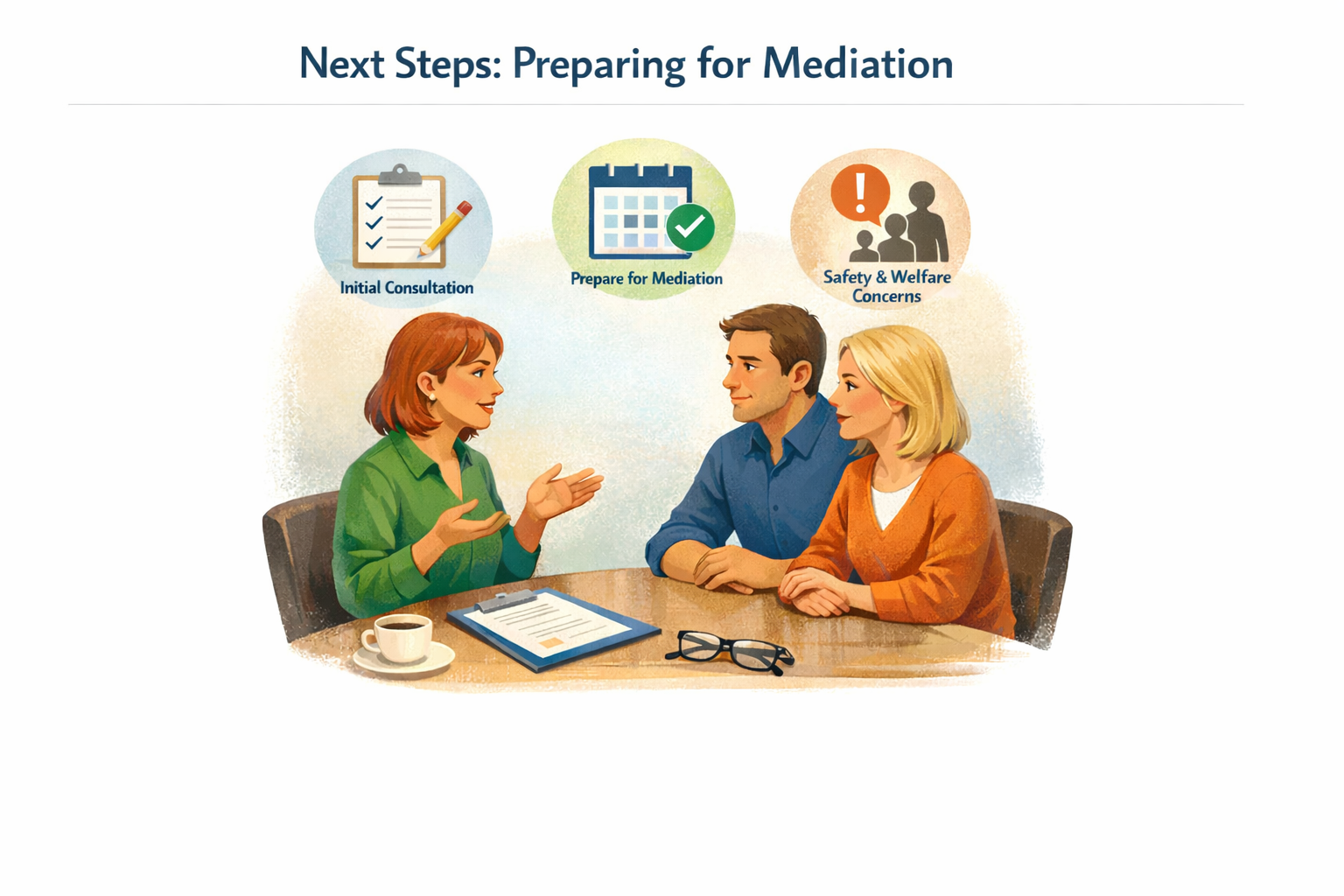
Mediation can be conducted in person or remotely, depending on individual circumstances and preferences. Both approaches follow the same structured process and produce the same quality of documented outcome.
Mediation produces practical, written agreements — not legally enforceable orders. Understanding what mediation can and cannot deliver helps families approach the process with realistic and achievable expectations.
Clear written records of what both parties have agreed — covering child arrangements, financial contributions, housing transitions, and communication frameworks. These documents reduce daily uncertainty and give both adults and children a reliable point of reference.
Many families find that within six months of completing mediation, life feels considerably more settled. Emotional strain is reduced, children's routines are established, and the need for ongoing legal intervention is substantially lower.
Mediation produces a private written record, not a court order. To make an agreement legally enforceable, it may be necessary to involve a solicitor or apply to the court. The mediator will always explain the available next steps clearly.
Where complex assets — such as property, pensions, or business interests — are involved, specialist legal and financial advice will almost certainly be needed alongside the mediation process. The mediator will identify these needs and encourage appropriate referrals.
Life changes. Mediation agreements can be revisited where circumstances alter significantly — for example, when a child's needs change, a parent relocates, or a financial situation shifts. Mediation can be used again to update arrangements in a way that is mutually agreed and properly documented.
Mediation does not remove the need for legal advice — it frequently reduces the extent to which it is required. Many families use the mediated agreement as a sound basis for their solicitors to work from, significantly shortening the time and cost of any subsequent legal process. The mediator will always encourage independent legal review where appropriate.

Mediators are experienced practitioners who operate to recognised professional standards in family mediation. They do not act as legal representatives for either party and are professionally bound to remain impartial throughout the process. Where specialist legal or financial issues arise, mediators encourage parties to seek independent advice.
Professional standards and UK best practice in family mediation are followed throughout. Specific qualifications and professional memberships are available for verification on request at the first meeting — accurate details are provided openly.
In every session, the mediator remains neutral, manages the process fairly, and ensures that both parties are able to participate fully and safely.
Safeguarding: The mediator will identify any urgent safeguarding concerns at the earliest opportunity and will always prioritise the safety and wellbeing of all parties — particularly children. Where safeguarding concerns arise, appropriate steps are taken without delay.
Confidentiality: What is discussed in mediation is confidential and will not be disclosed without the agreement of both parties, except in rare situations required by law — such as child protection disclosures. The limits of confidentiality are always explained clearly at the outset.
Power imbalances: Mediators are trained to recognise and respond to power imbalances. Steps are taken to ensure the process remains fair and that neither party is placed at a disadvantage. Where mediation is not safe or appropriate, alternatives are suggested.
Mediation does not end when a written agreement is signed. A follow-up check is offered to confirm that arrangements are functioning as intended and to address any practical issues that have arisen since the agreement was finalised.
Where circumstances change — through a child's evolving needs, a parental relocation, a shift in financial situation, or any other significant life event — mediation can be used again to review and update arrangements in a structured and mutually agreed way. Returning to mediation for a review is often far more straightforward than the original process, and agreements can be updated without the need to return to court.
Where the written agreement requires further steps — such as legal formalisation or full financial disclosure — the mediator will explain the most common next actions clearly and provide an accurate record of what was agreed as a basis for those steps.
Practical family arrangements are not static. Children grow, circumstances evolve, and what works well at one stage of a child's life may need to be adjusted at another.
Mediation provides a reliable, low-conflict mechanism for managing these changes — ensuring that adjustments are made thoughtfully, transparently, and with the agreement of both parties.
This ongoing availability of mediation support is one of the reasons families find that the process delivers lasting value, well beyond the initial agreement.
Family mediation is a voluntary and confidential process where a trained, neutral mediator helps people discuss and reach practical agreements on matters arising from separation or family change. The mediator does not make decisions — they help both parties find solutions they can agree on themselves.
A mediation agreement is a private record of what has been agreed. To make it legally enforceable, it may be necessary to ask a solicitor to prepare a formal document, or to apply to the court for a consent order. The mediator will explain the available options once an agreement has been reached.
The number of sessions depends on the complexity of the issues and how ready both parties are to engage constructively. Some straightforward matters can be resolved in a small number of sessions; more complex financial or property discussions generally take longer. A realistic timeframe is discussed at the outset.
Solicitors may attend parts of a mediation session if all parties agree. Typically, mediation is conducted with both people present and the mediator facilitating. Many people choose to take the mediated agreement to their legal adviser for review once it has been reached.
Yes. What is said in mediation is confidential and will not be disclosed without the agreement of both parties, except in rare situations where disclosure is required by law — for example, where child protection concerns arise. The limits of confidentiality are explained clearly at the start of every engagement.
Mediation is voluntary. If one party declines to participate, mediation cannot proceed. However, the mediator can explain available alternatives and help explore whether a later attempt at mediation might be appropriate once circumstances have changed.
Children are not usually present in mediation sessions. Where appropriate, and always with the child's welfare foremost, the mediator can use age-appropriate approaches to listen to children's perspectives and help parents consider those views when making arrangements.
Gather any documents relevant to the discussion — school timetables, term dates, household bills, a basic budget. Think about what matters most to you and where you might be prepared to be flexible. Consider writing down your three most important priorities before the first session.
Mediation itself does not compel disclosure, but fair financial decisions depend on accurate information. Transparent discussion is strongly encouraged, and the mediator will explain which documents are likely to be needed to support clear and fair decision-making.
Yes. Online sessions follow the same structured process as in-person mediation and are conducted via a secure digital platform. Identity and confidentiality are confirmed at the outset, and the quality and reliability of outcomes are consistent with face-to-face practice.
Agreements can be revisited through mediation if circumstances change significantly. Mediation can be used again to update arrangements in a mutually agreed way — often a quicker and less costly process than the original mediation.
Mediation may not be appropriate where there are serious safeguarding concerns, ongoing coercive or controlling behaviour, or where one party is unable to participate freely. Suitability is assessed carefully at the outset, and safe alternatives are suggested where mediation is not appropriate.
The following accounts are anonymised and simplified to illustrate the kinds of outcomes mediation makes possible. Each reflects a genuine type of situation where mediation provided practical and lasting support.
Two parents who had been sharing childcare informally separated and were concerned about disrupting their child's school routine. Through mediation, they agreed on a stable weekly timetable, clarified morning and evening handovers, and established a simple holiday-sharing plan. The written agreement reduced daily tension and gave both parents a clear reference point when plans needed to change.
A couple who jointly rented a property needed to decide how household bills would be managed while one partner prepared to move out. Mediation produced an interim financial plan that allocated contributions fairly and set dates for reviewing longer-term arrangements — avoiding rushed decisions and reducing the risk of financial dispute.
A family with shared care that included regular grandparent contact faced uncertainty following a parental relocation. Mediation created a clear contact schedule that acknowledged school commitments and travel time — protecting the children's routines while preserving significant relationships.
The mediator helped us speak calmly and reach an agreement that really works. Our children are less anxious, and routines are clear.
— Verified client testimonial
Practical, fair, and straightforward. We left with a written plan we both understood and could rely on.
— Verified client testimonial
We thought court was the only option. Mediation gave us control and cut months of stress.
— Verified client testimonial

Mediators are committed practitioners with experience in the full breadth of family mediation — from straightforward parenting arrangements to complex financial separation and multi-party discussions. They work to recognised UK professional standards and approach every engagement with impartiality, clarity, and genuine care for the families they work with.
The practical qualities a client can expect: clear explanations in plain English, structured and fair session management, and a consistent focus on realistic outcomes that function in everyday life. The approach is compassionate, pragmatic, and — where children are involved — firmly child-centred.
Every family brings different circumstances, different communication styles, and different priorities. Mediators adapt their approach accordingly, giving each person the space to be heard while keeping discussions productive and purposeful.
Where specialist issues arise — in relation to property, pensions, complex assets, or other legal matters — mediators will always encourage independent advice to be obtained. The mediator's role is not to advise but to facilitate: helping families identify their priorities, explore their options, and reach agreements they can live with.
Inclusive practice is central to how mediation services are delivered. Reasonable adjustments are available to ensure full participation — including remote sessions, plain English summaries, scheduling flexibility, and language support where required. All parties are treated with dignity and respect.
Family mediation exists to reduce conflict, protect children, and help adults make decisions they can genuinely live with — without the strain and cost of prolonged legal proceedings. The most significant changes in family life deserve a thoughtful, structured, and professional response.
For families willing to approach their situation practically and constructively, mediation offers a route to lasting, workable arrangements — arrangements shaped by the family's own priorities and grounded in the realities of everyday life.